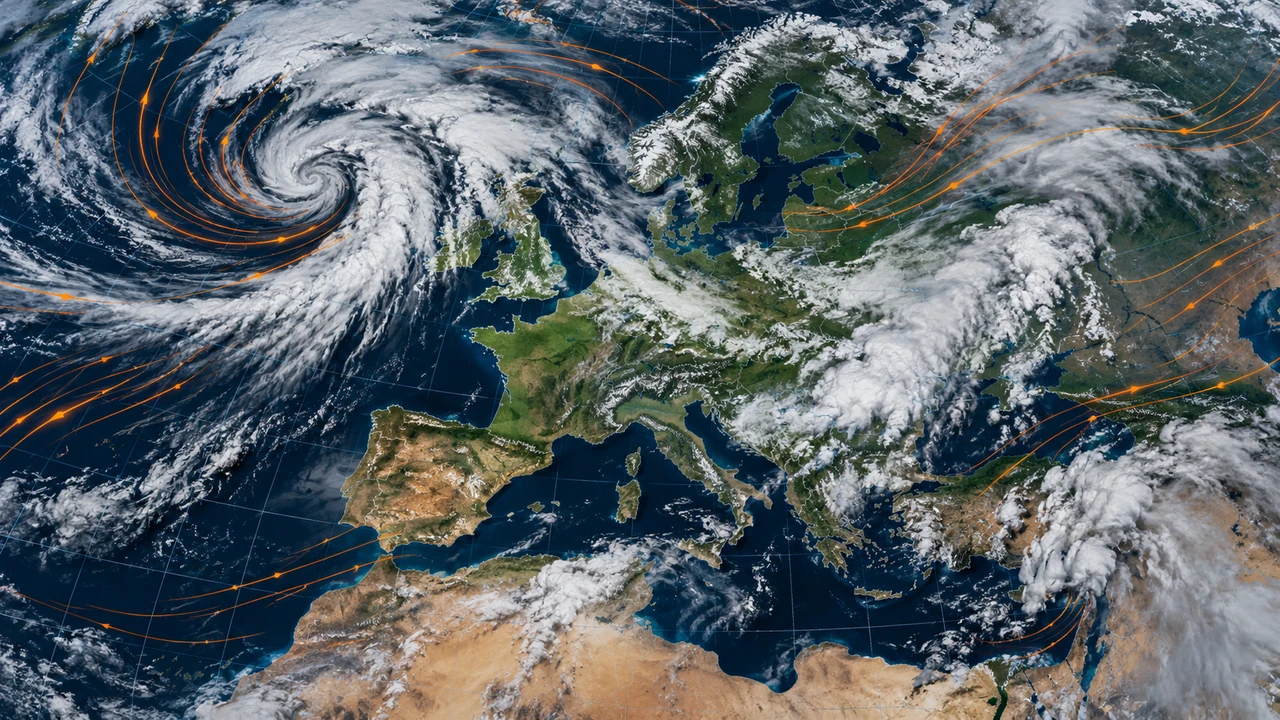
With WeatherNext 3, Google DeepMind combines recent satellite observations and AI to produce a new global forecast every hour, at resolutions that can reach five kilometres.
Far more detailed global weather
Presented on 3 September 2026, WeatherNext 3 is a major step for AI-based forecasting.
Its predecessor mainly used a 25-kilometre grid and six-hour updates. The new system can reach five kilometres for some variables and refresh every hour.
Satellites feed the model directly
WeatherNext 3 ingests mosaics from geostationary satellites, giving it a fresher view of clouds, fronts and precipitation.
It also learns from ground stations, helping it estimate local conditions even in places sparsely observed during training.
Rain remains the hardest test
Rain and snow depend on fast, local mechanisms that global models often smooth out. Google reports gains on several measures, but they do not imply equal improvement for every forecast.
The figures refer to specific statistical tests, reference datasets and forecast horizons.
Uses beyond the weather bulletin
The model also estimates wind at turbine height, cloud cover and solar radiation, which can support power grids, farming, aviation, logistics and risk prevention.
It is beginning to appear in Google services, while researchers and businesses can access some data through cloud services.
AI does not replace weather services
Even a highly detailed forecast remains uncertain. The atmosphere is chaotic, observations are incomplete and rare events can be misread.
WeatherNext 3 is therefore a complementary tool; official warnings and safety decisions remain the responsibility of national weather agencies.


Comments 0
Be the first to comment on this article.