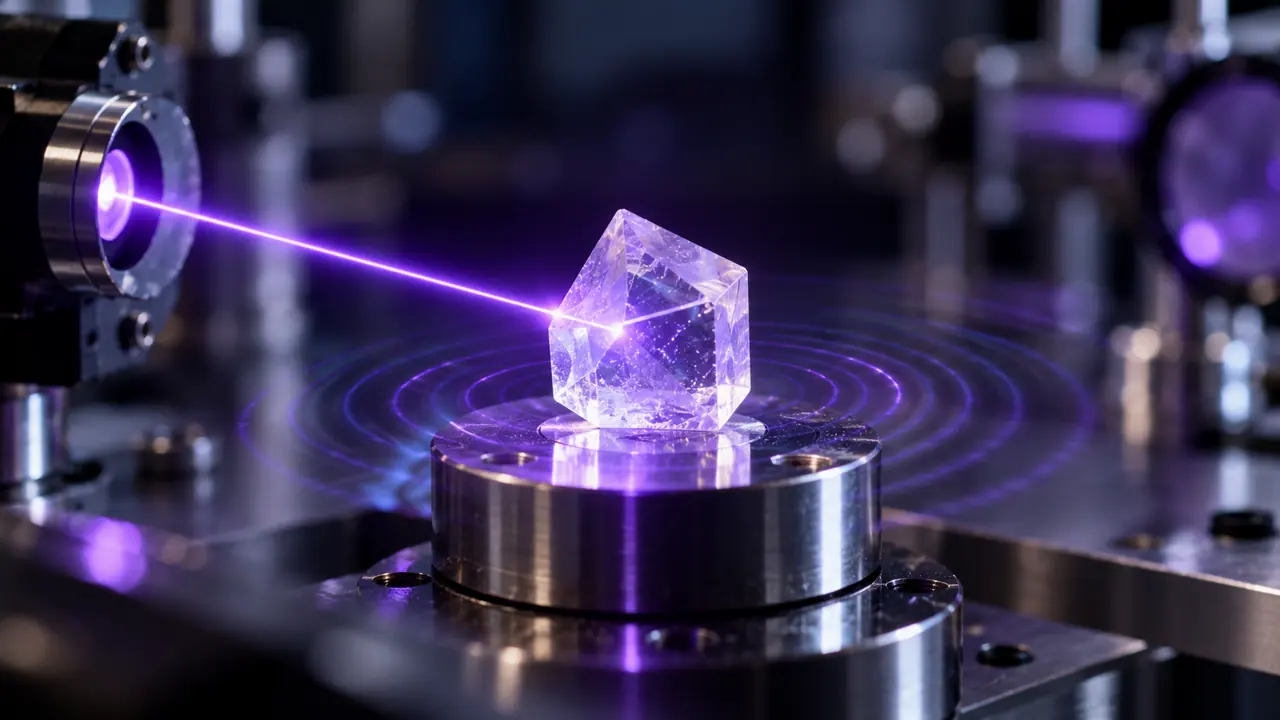
Here, nuclear means neither a reactor nor electricity generation. The clock measures a frequency associated with a state change in the thorium-229 nucleus, whereas current atomic clocks mainly use electronic transitions.
From concept to a closed-loop clock
Thorium-229 has a nuclear transition accessible with ultraviolet laser light. In one Nature experiment, the nuclei are embedded in a millimetre-scale calcium-fluoride crystal at room temperature.
A feedback loop stabilises the laser on that transition. This locking process turns a spectroscopic observation into an operating clock system.
A major step, but not yet a record
Two independent experiments strengthen the case that the principle is reproducible. The prototypes still do not outperform the best atomic clocks.
Challenges include ultraviolet lasers, crystal quality, environmental disturbances and long-duration comparisons.
Navigation, networks and fundamental physics
A crystal can contain a very large number of nuclei interrogated at once. That could eventually produce compact, robust references for networks, navigation and metrology.
The clocks could also search for tiny changes in fundamental constants or test some dark-matter scenarios. This is scientific potential, not a discovery already made.
Conclusion
The 7 October milestone moves the nuclear clock from concept to a laboratory system that operates in a loop. Everyday applications now depend on major gains in accuracy, reliability and simplicity.


Comments 0
Be the first to comment on this article.