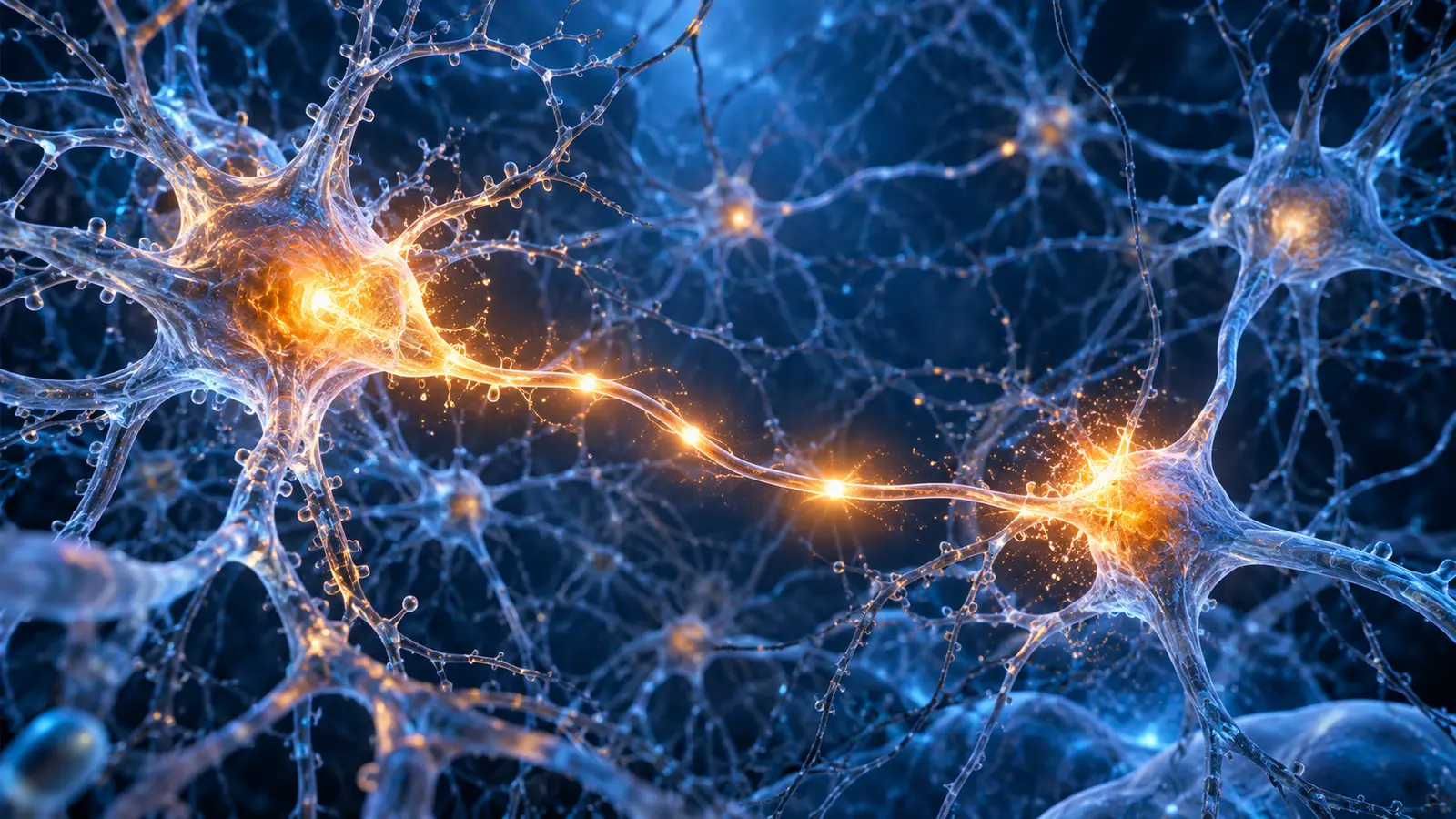
Understanding a disease often means understanding what has gone wrong. In the brain, this is particularly difficult: seeing several cells become active together does not establish what each one does. The Nobel announced on 5 October highlights a tool that changed how researchers approach that question.
Proteins that respond to light
Peter Hegemann and Georg Nagel’s work on proteins found in algae established the properties of light-sensitive ion channels. Karl Deisseroth and his colleagues subsequently developed their use for precise control of neuronal activity. Optica, the scientific society for optics and photonics, confirms these contributions in its 5 October announcement.
The principle brings biology and light together: selected cells made sensitive to light can respond to illumination. This specialised experimental tool has helped researchers investigate connections between nerve activity and behaviour. It should not be confused with the idea that a human brain can simply be controlled remotely.

From observing a connection to testing a cause
The scientific value lies in intervening in selected cells and examining the effects. Nature’s collection published on 5 October recalls how discoveries in the early 2000s paved the way for this development.
Our analysis: distinguishing the underlying mechanisms more clearly can help researchers formulate more precise treatment hypotheses. That remains one stage in a research process. Understanding a function, designing an intervention and demonstrating benefits for patients are three different tasks.
Vision provides a concrete, but limited, example
A paper by José-Alain Sahel and colleagues, published online in Nature Medicine on 24 May 2021, describes partial recovery of visual function in a patient with retinitis pigmentosa. The approach combined an optogenetic intervention with specialised goggles. The result concerned visual tasks performed with this device; it did not amount to a complete restoration of normal sight.
This study, published before the Nobel award, illustrates a clinical possibility. However, an individual result cannot establish general effectiveness or availability for everyone with impaired vision. Safety, the duration of benefit and conditions of use must be established for each approach.
What patients can expect from this recognition
The immediate change is principally greater visibility for a scientific field. Readers can usefully identify what an announcement actually describes: an experiment, a clinical trial, an authorisation or an available treatment. These stages are not interchangeable.
The Nobel recognises a transformation in research. Its significance for health lies in gradually turning knowledge into interventions with demonstrated benefits. Hope deserves to be explained as precisely as the limitations.


Comments 0
Be the first to comment on this article.