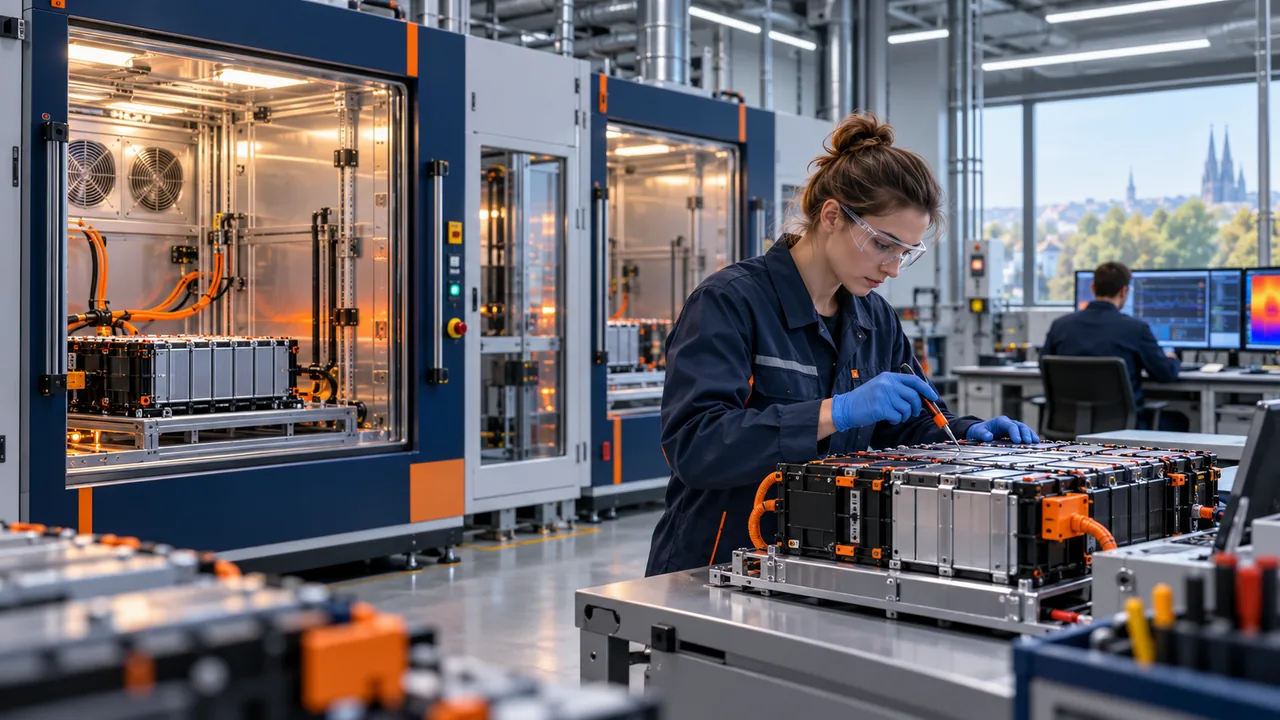
A battery cannot be judged solely by its first kilometres or first hours of storage. Understanding how it ages and behaves under different conditions is essential. Europe’s MISTRAL project aims to accelerate this often lengthy stage between designing a system and validating it.
A research programme now under way
IREC reports that the kick-off meeting took place on 14 October 2026 in Barcelona. The official CORDIS record gives a start date of 1 October 2026 and an end date of 31 March 2030. Eurecat coordinates an 18-partner consortium. The stated EU contribution is approximately €7.46 million.
This MISTRAL is a battery-validation project, separate from the French AI company in the CERN news. Its scope runs from cells to battery packs, with use cases involving an electric passenger car, an electric bus and stationary storage.
Combining measurements and models
The approach brings together physical tests, simulation and AI-assisted experimental design. A model could help select the most informative tests or interpret early signs of ageing. The challenge is to obtain useful validation evidence without always waiting for lengthy test campaigns.
CORDIS lists objectives including validation cycles shortened by up to 40% and costs reduced by up to 30%. These are programme targets. Presenting them as savings already achieved would be misleading.
Faster testing requires clearer limits
A virtual test is useful only when its relationship to measured behaviour is sufficiently established. Teams will therefore need to specify covered situations, error margins and conditions requiring additional tests. Good predictions for one family of cells do not guarantee equivalent quality for every chemistry or use.
For vehicle buyers and storage operators, the potential benefit is better knowledge of lifetime and reliability. Lower final prices do not automatically follow from better testing: other costs and commercial decisions also play a role.
The expected outcome is therefore not a miracle battery. It is a method whose performance can be compared with measurements and then reused within clearly documented limits.



Comments 0
Be the first to comment on this article.