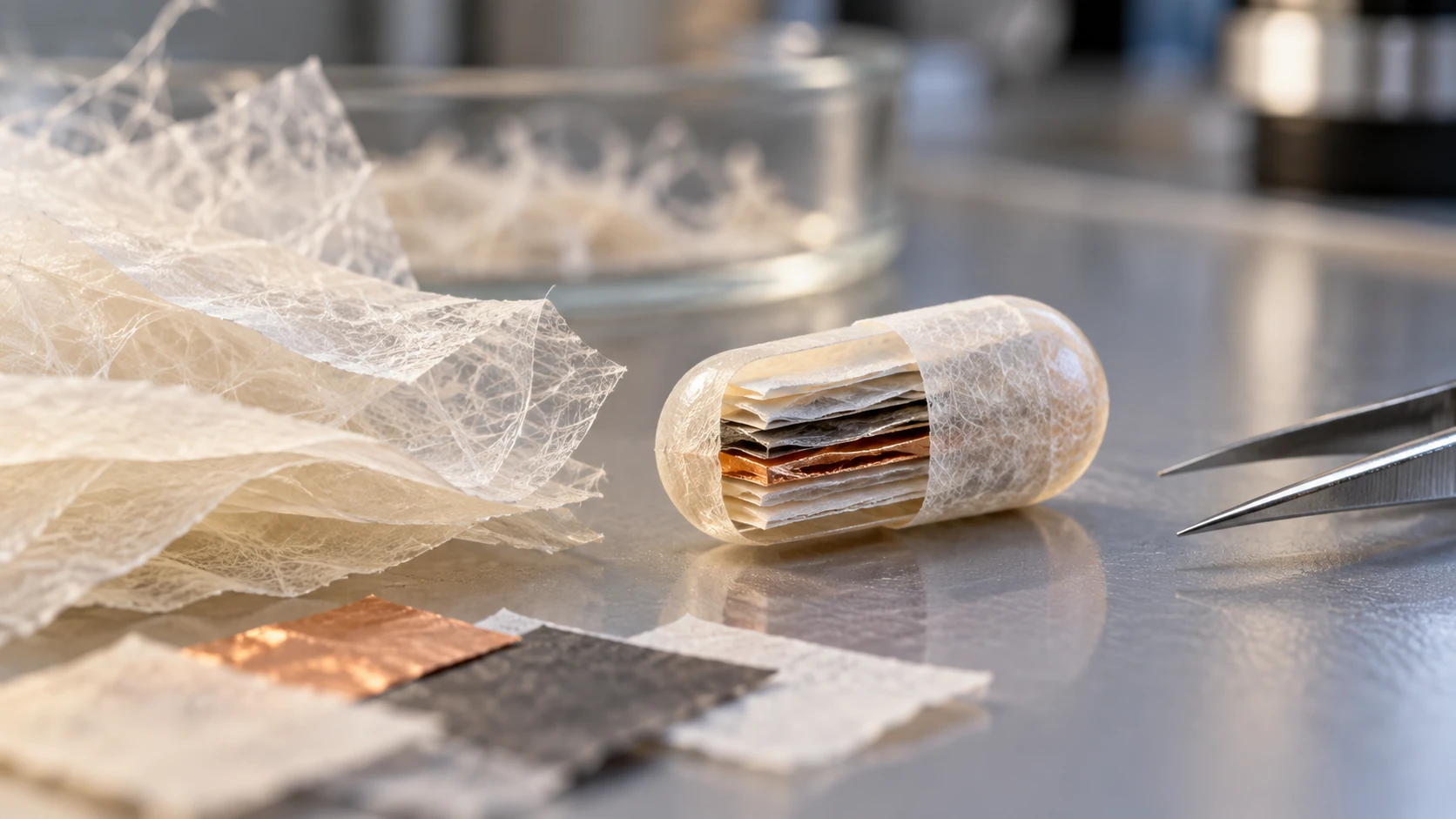
How can a device work briefly inside the body and then disappear? Researchers are exploring a bioresorbable paper battery. Their study connects this power source with small experimental electronic devices.
Research rather than an available medical product
Bioresorbable batteries for transient ingestible bioelectronics was published on 21 September 2026 in Nature Chemical Engineering. Nature Portfolio’s announcement the following day confirms that these are preclinical experiments, including tests in pigs.
A power source designed to degrade
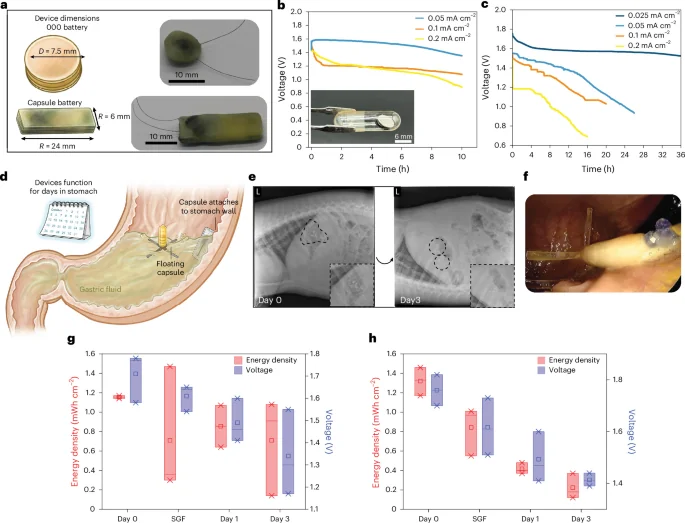
The team uses a magnesium–molybdenum trioxide battery on a paper substrate and reports a peak open-circuit voltage of 1.84 volts. This figure describes an electrical characteristic; it establishes neither treatment efficacy nor universal safety.
Functions tested under controlled conditions
Experiments include a radio tag intended to track ingestion and a capsule for gastric stimulation. The researchers also examine battery retention in the stomach for three days. These observations provide a feasibility demonstration limited to the study protocol.
Not all the electronics disappear yet
The stimulation circuit is not entirely biodegradable. Animal sample sizes are limited and long-term safety requires further study. Our analysis: controlling degradation matters as much as supplying energy; the device must function throughout its useful lifetime.
Conclusion: a step towards temporary devices
The battery addresses a technical obstacle for ingestible electronics. It does not yet validate clinical use in humans. Progress will depend on broader assessments of safety, reproducibility and the complete device.


Comments 0
Be the first to comment on this article.