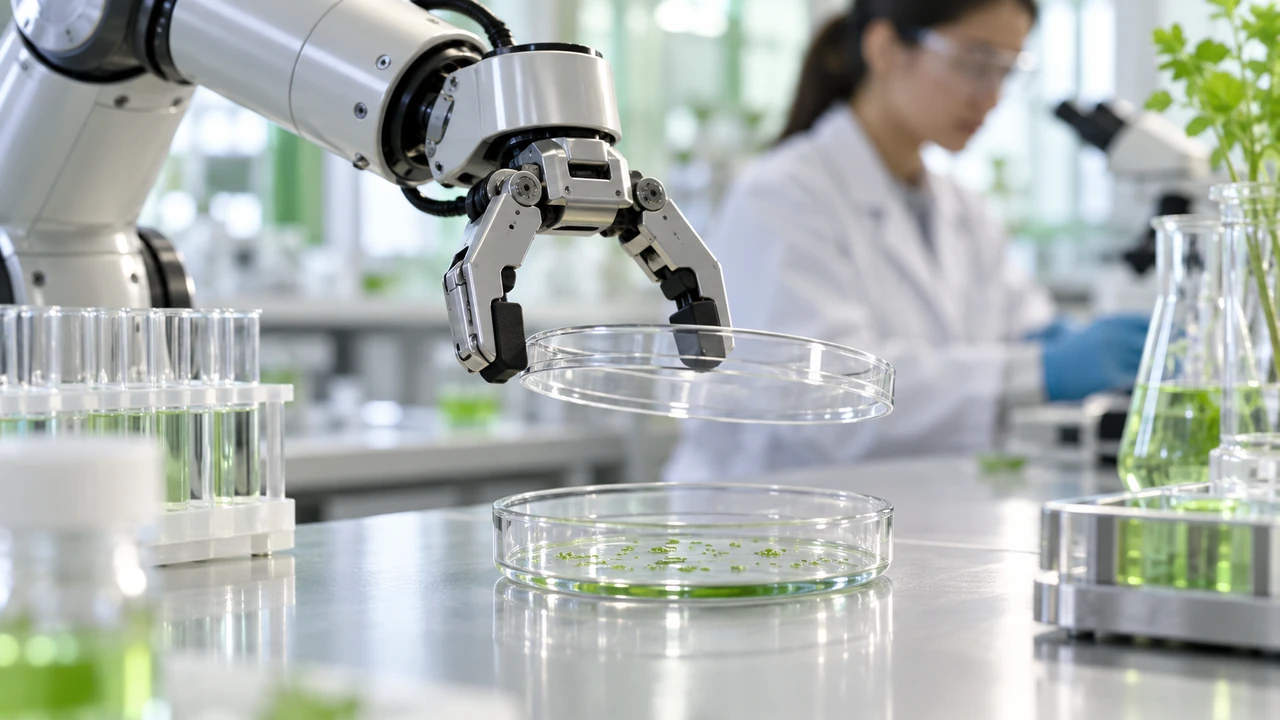
Moving a robot into another laboratory can be enough to disrupt its operation. WetRobo explores a solution: let a coding agent observe the installation and adapt control programs to the new environment.
Research published in September
The preprint WetRobo: A Reproducible Robot Kit for Coding Agents in Biological Laboratories, submitted on 16 September 2026, describes a combination of a robot arm, laboratory equipment, programs and demonstrations.
The authors investigate requesting tasks in natural language without locally training a new neural network.
Three concrete actions within a limited scope
The team reports success in lifting a Petri dish lid, removing a bottle cap and opening an incubator door. These trials use an OpenAI Codex coding agent.
For cap removal, the authors report success in two laboratories. The comparison vision-language-action model, fine-tuned on demonstrations from the first laboratory, did not achieve that transfer in their experiment. This finding remains specific to the studied protocol.
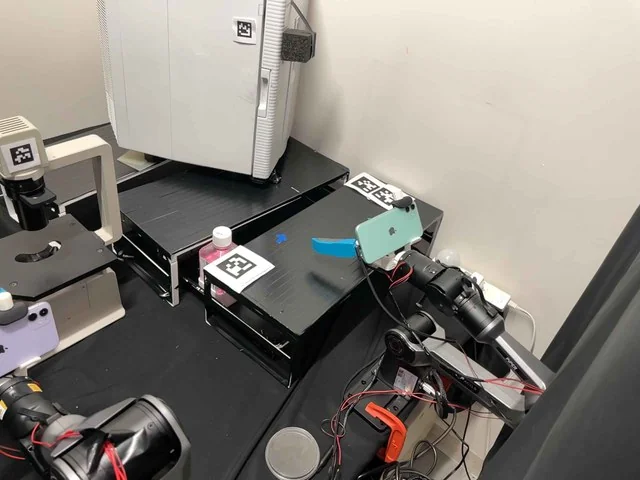
Adapting a program rather than retraining everything
The public repository supplies resources for examining the project. This openness makes the method easier to inspect; it does not replace independent replication.
Our analysis: the approach is interesting for installations whose layout changes. It nevertheless shifts part of the problem towards checking the generated program and the movement it controls.
Successful actions do not make an autonomous laboratory
Handling a container does not establish the ability to conduct a complete biological experiment. Contamination control, traceability and repeatability should form part of a broader evaluation.
Failures, human corrections and stability over many repetitions also need measurement.
Conclusion
WetRobo provides an example of robotics made adaptable through software. The first demonstrations open a direction, but their scope remains limited: automating a few actions does not yet validate an entire experimental workflow.
Comments 0
Be the first to comment on this article.