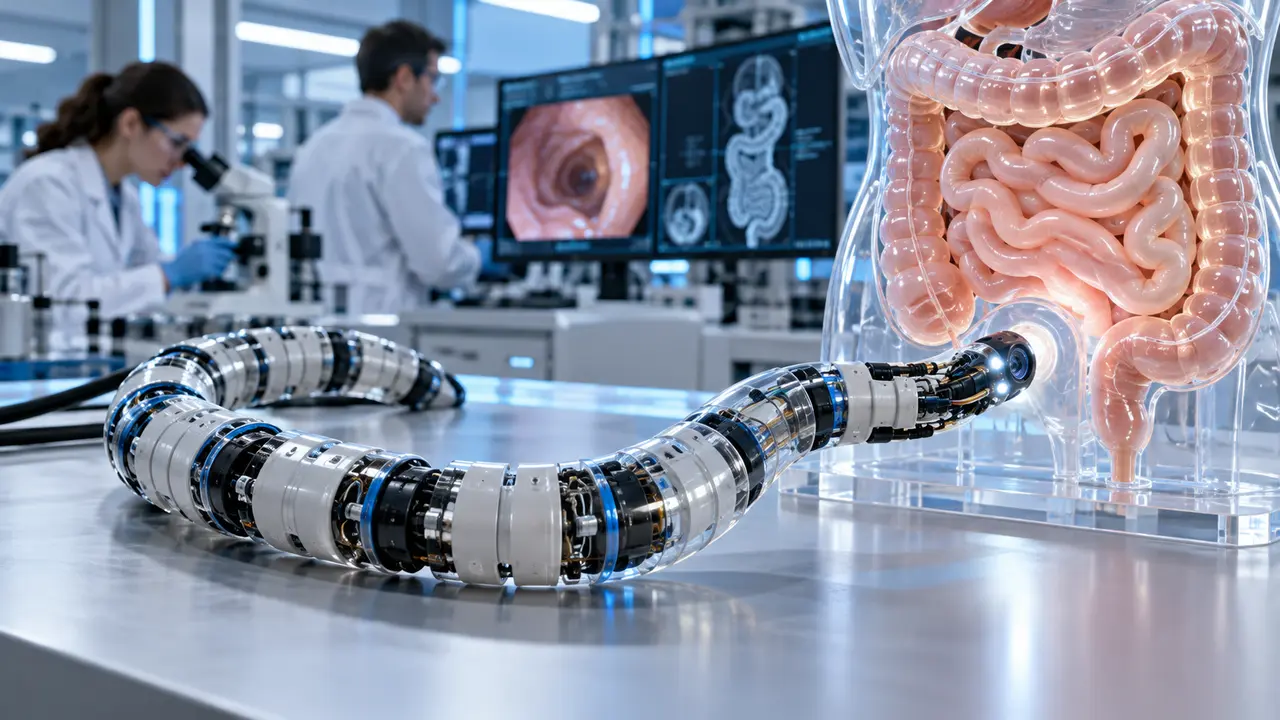
BIOSENTER: the soft robot that aims to explore the intestine gently — 1
The small intestine’s length, folds and slippery lining make bleeding, inflammatory disease and tumours difficult to locate. Double-balloon enteroscopy can reach deep areas, but it is slow, demanding and performed by relatively few specialists. BIOSENTER is a tethered soft tube. Pneumatic chambers make it extend and bend, while front and rear balloons alternately anchor it. Kirigami-patterned sleeves unfold like scales to grip the mucosa without relying on excessive tissue stretching.
BIOSENTER: the soft robot that aims to explore the intestine gently — 2
In the *Science Robotics* study, the device travelled roughly 6.5 feet, or two metres, through porcine intestine. The team also demonstrated imaging, liquid delivery and clips for biopsy or small-polyp removal. This is a multifunctional preclinical platform, not proof of superiority over current procedures. It is still operator-controlled and tethered; future autonomous navigation remains a research aim.
BIOSENTER: the soft robot that aims to explore the intestine gently — 3
Before human trials, engineers must assess longer distances, repeatability, tissue injury, sterilisation, usability and direct comparison with double-balloon enteroscopy. If those hurdles are cleared, patients could benefit from combined imaging, biopsy and targeted drug delivery, while hospitals might reduce dependence on scarce technical expertise. The robot would support, not replace, the gastroenterologist.
Conclusion
Conclusion — BIOSENTER has not transformed endoscopy yet. It has shown that soft robotics can unite locomotion, imaging and intervention in delicate anatomy. Rigorous safety work now comes first.
Comments 0
Be the first to comment on this article.