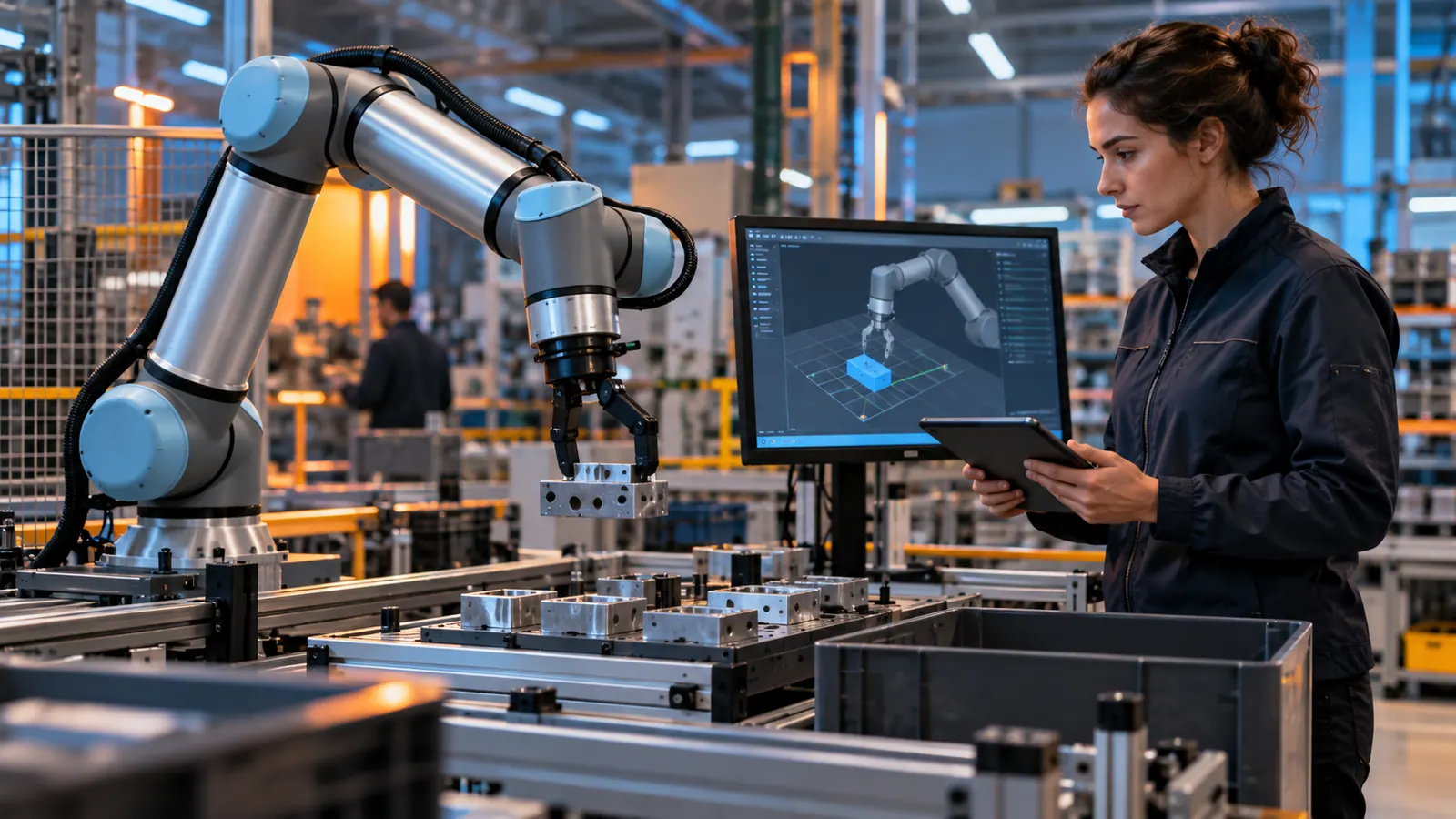
Seeing an object does not always tell a robot whether it has grasped it correctly. Part of the challenge of industrial robotics lies in that gap between perception and action. Presented by NEURA Robotics, Neuron AI aims to help machines draw on richer physical experience. The announcement raises a practical question: how much human work is still needed to turn a demonstration into a reliable task?
Learning a movement rather than making a video succeed
The German manufacturer describes an architecture combining vision, touch, sound and memory, among other inputs. Its Neuraverse platform is intended to adapt skills and deploy them across a fleet. These capabilities are described by the company; by themselves they are not an independent measure of production reliability.
The interesting shift concerns how progress is measured. An impressive movement says little about the time needed to learn another task. For a factory, the useful question is often less spectacular: what happens when the component, its packaging or its location changes? A solution that is too expensive to adapt may lose some of its value.
Teams’ expertise becomes a resource
An industrial procedure is more than a trajectory. It includes clues, habits and exceptions that operators can recognise. Our analysis: collecting this expertise can create additional work before saving time. It is therefore worth examining who prepares examples, corrects mistakes and validates the result.
This change does not establish a number of jobs created or lost. It may alter how work is divided between operation, training and checking. The quality of the transition would depend as much on organisation as on the computing model.
Sharing a skill does not mean sharing the entire factory
NEURA says customers can keep certain skills private and choose whether to contribute to sharing data or expertise. The optional nature of that sharing must remain explicit in every translation of this article.
Our analysis: a company will need to distinguish the general model, its own adjustments and information generated by its operations. A training video can reveal a process, a component or a workplace. The promise of a more adaptable robot therefore does not remove the need to examine confidentiality commitments and each party’s responsibilities.
An announced demonstration is not yet a track record
NEURA has announced a demonstration of its 4NE1 humanoid handling laundry at NVIDIA GTC Berlin, from October 20 to 22. As of October 15, this must be described as a forthcoming event, not a result already observed at that show.
To assess what follows, useful criteria will include repeatability, human interventions and the time spent adapting the system. A one-off success and a skill usable every day do not meet the same requirement.
Conclusion
Neuron AI illustrates a major ambition: making robots easier to teach. For readers and companies, the next indicator to watch will be less their resemblance to humans than their ability to learn a useful task without making costs, data or mistakes harder to control.
Comments 0
Be the first to comment on this article.