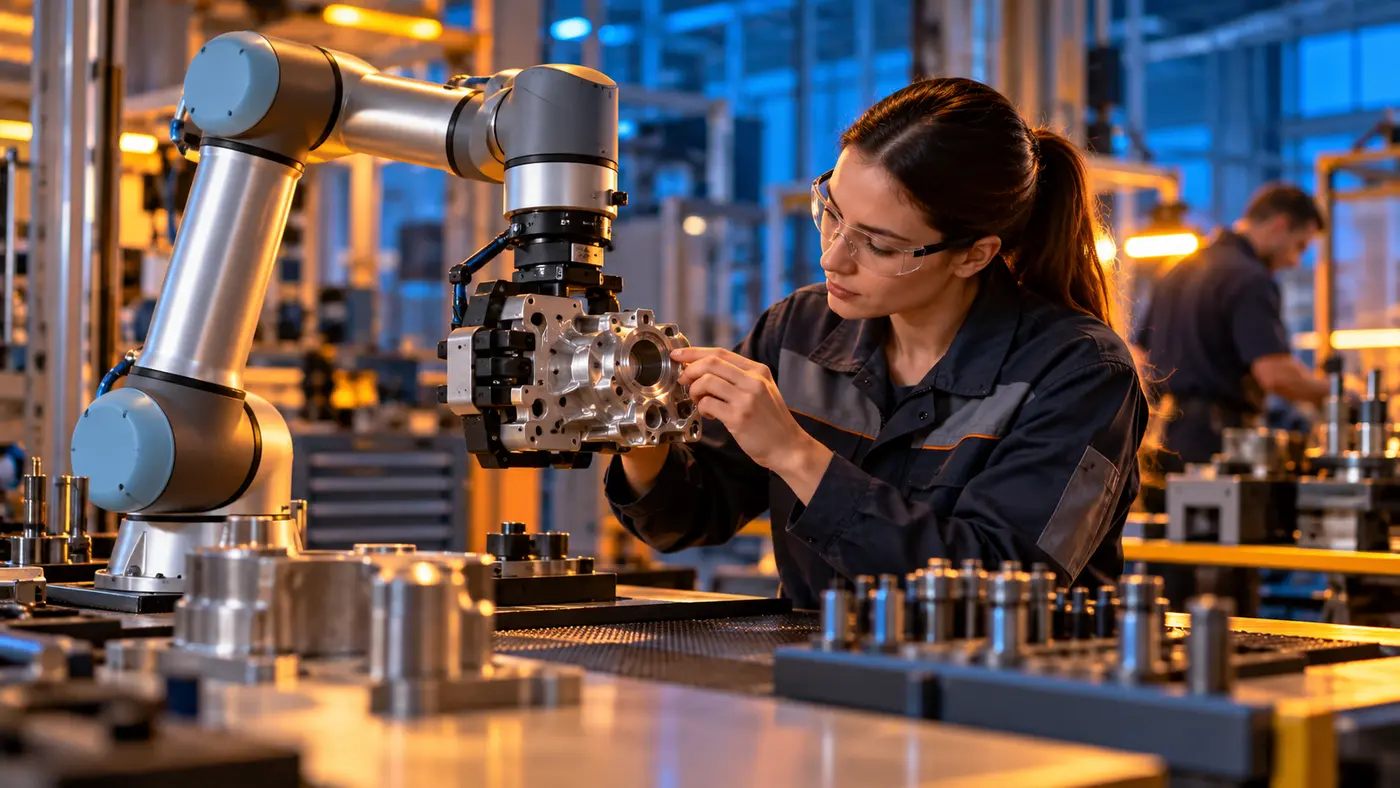
Collaborative robotics aims to assign repetitive, strenuous or highly precise movements to a machine while keeping people at the centre of decision-making and work organisation.
Production and assembly
In industry, a cobot can present a part, hold a tool or repeat a precise movement. The operator retains tasks requiring judgement, adaptation and quality control.
Success depends on workstation ergonomics and how easily the system can be reconfigured when production changes.
Logistics, healthcare and agriculture
In logistics, robots carry loads and reduce unnecessary travel. In healthcare, some devices assist rehabilitation or patient handling. In agriculture, machines target repetitive operations such as weeding.
These uses require a risk assessment specific to each environment and appropriate staff training.
A transformation of the occupation
Work does not automatically disappear: it shifts towards preparation, supervision and maintenance. This can improve working conditions, but only if employees take part in designing the new process.
The right indicator is not the number of robots installed, but the genuine reduction in strain and the lasting improvement in quality.


Comments 0
Be the first to comment on this article.