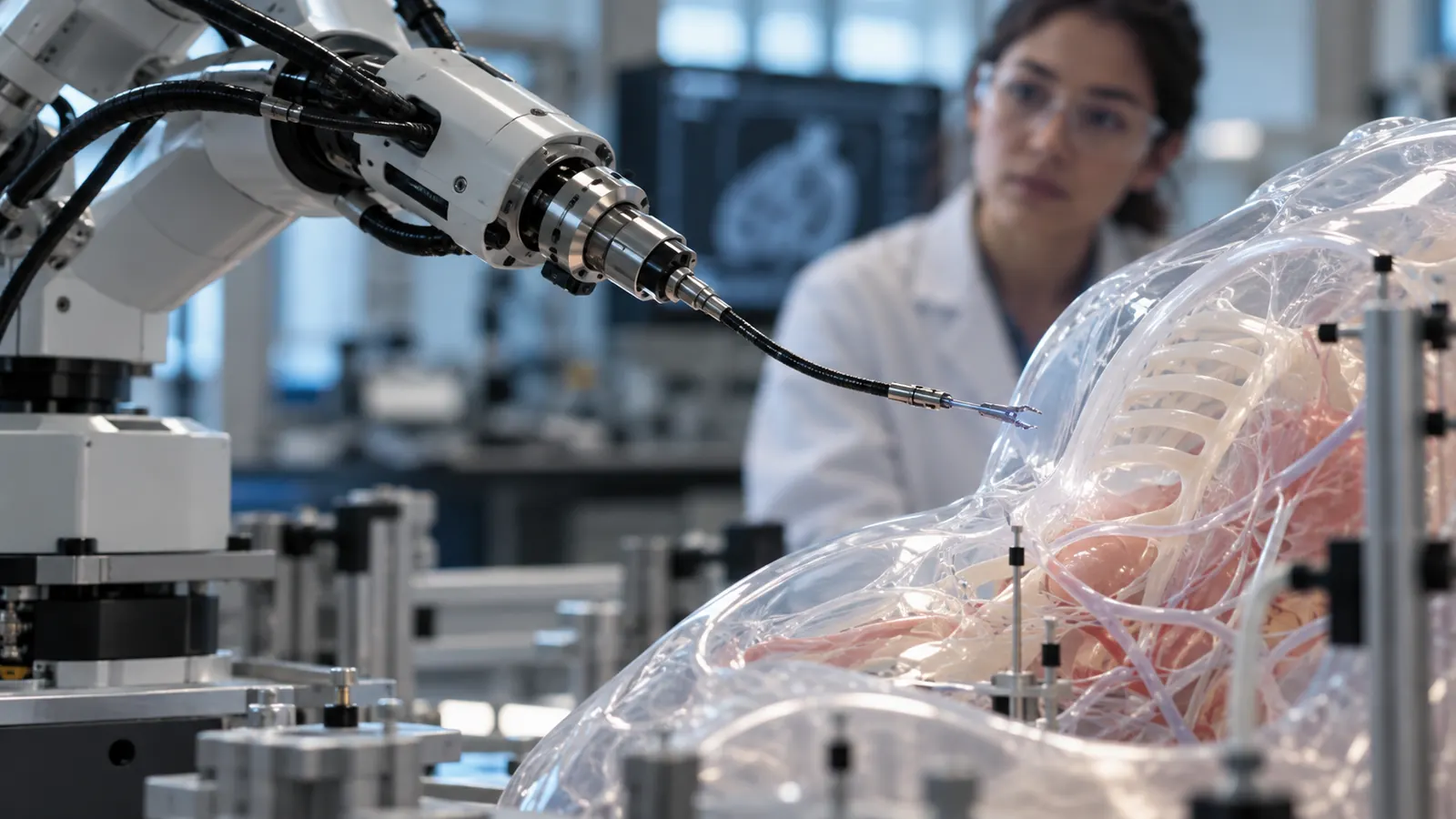
In surgery, reducing an instrument’s size is not enough: its tip must still be steerable. That is the problem addressed by a team led in this publication by Jinshi Zhao and colleagues. Their work on “fiberbots” explores an approach in which a flexible structure accompanies an instrument into a hard-to-reach space.
Movement concentrated in the right place
The described prototype measures 1.9 millimetres in diameter and 1.2 metres in length. The authors report positioning accuracy below 100 micrometres, or one tenth of a millimetre. These values describe their tests; they do not promise a clinical outcome.
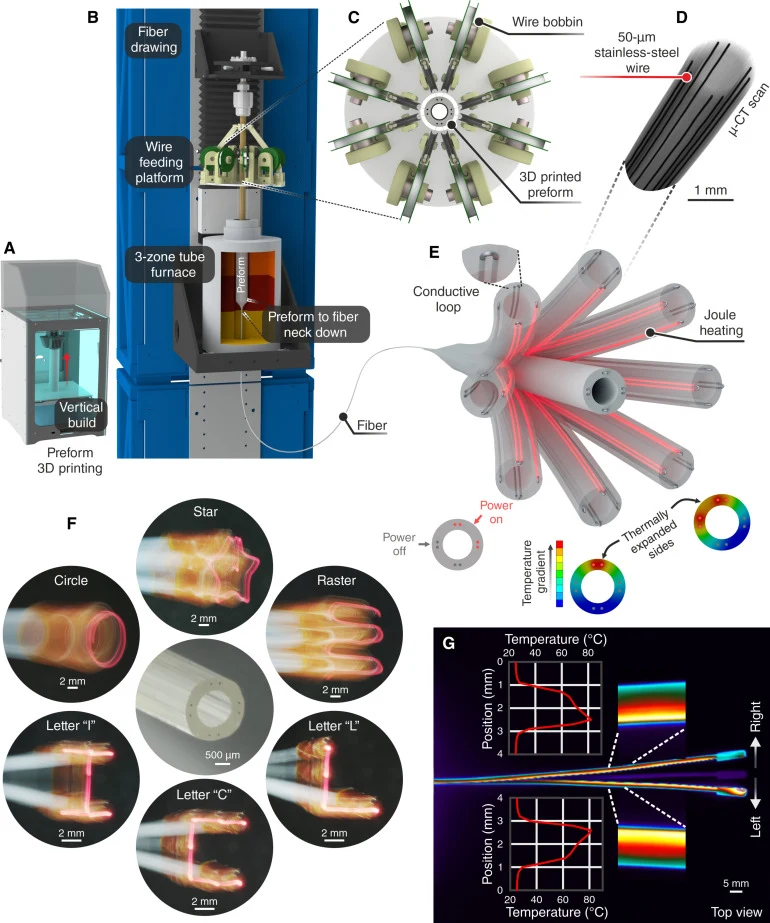
The principle studied concentrates thermal actuation in the distal section, near the working tip. The scientific question is therefore how to produce precise local movement without requiring the entire length to behave in the same way. The robot remains a controlled tool, not an autonomous surgeon.
A demonstration on a model, not a real tumour
The publication describes experimental integration with a da Vinci instrument and a model simulating an abdominal environment. The path followed around a simulated area demonstrates a possible guidance method. The experiment establishes neither cancer removal in humans nor improved survival.
The authors still identify limitations involving temperatures and insulation, among other issues. The work’s journalistic interest lies as much in these open questions as in the fineness of the movement. A precision measurement alone does not cover every requirement of medical use.
A new study within an existing line of research
Robotic fibres did not begin with this submission. A study published in Science Advances in 2024 had already explored this family of instruments and preclinical tests. It provides scientific background, not automatic validation of the device presented in 2026.
That distinction matters for images as well as text. Showing an earlier experiment without its date could suggest that the new prototype has already passed the same stages. Generations, testing methods and results must remain identifiable.
What readers should wait for before calling it care
Our analysis: the right question is not simply whether movement is precise, but whether that precision remains useful and safe under medical-use conditions. Answers will require appropriate evaluations and comparison with existing solutions. The consulted preprint provides no basis for announcing a date of availability in care.
For patients, this research is therefore information about a possible future for instrumentation, not a therapeutic recommendation. For medical teams, it illustrates a development direction that still needs placing within the overall procedure and its validation.
Conclusion
The advance presented concerns an experimental tool, not an available treatment. By combining flexibility and precision, fiberbots contribute to a promising line of medical robotics. Their future value depends on evidence beyond the laboratory, which it would be premature to announce today.

Comments 0
Be the first to comment on this article.