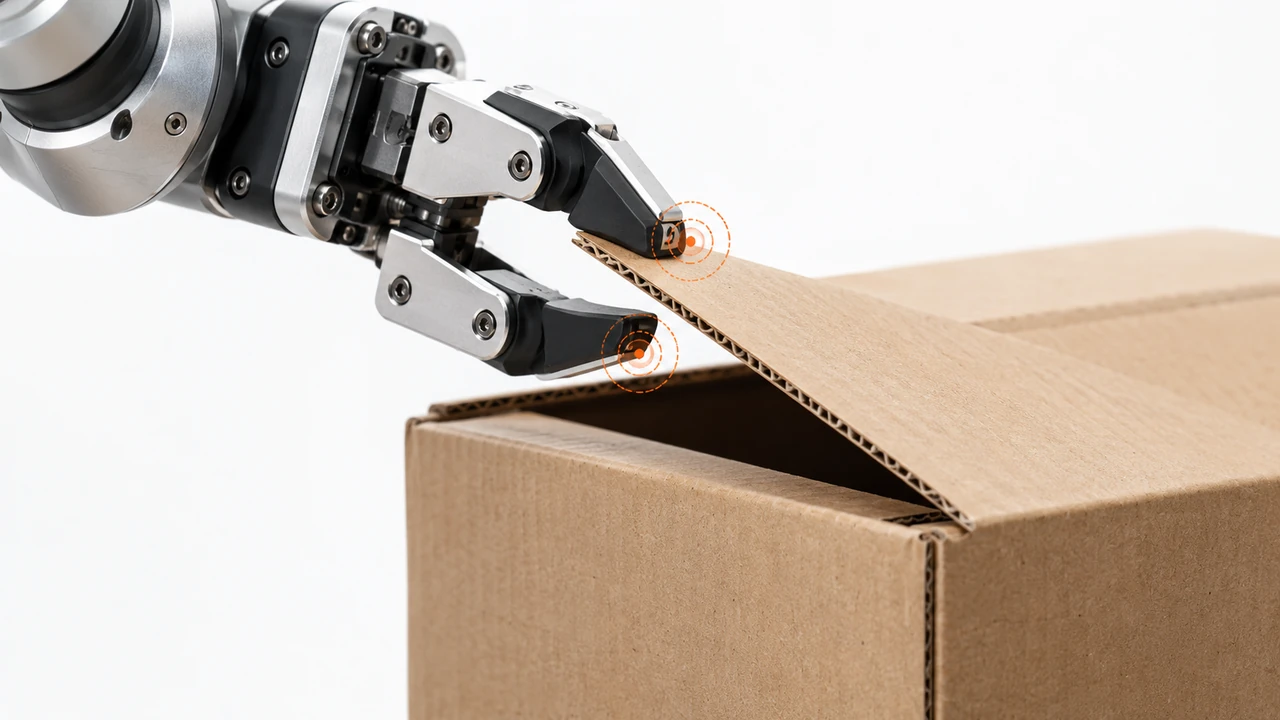
Opening a box seems ordinary. For a robot, it involves locating a seal, guiding a tool and handling a deformable material. BoxBot uses this task to explore more adaptable automation.
A demonstration announced for IROS
In an announcement dated 22 September 2026, Viam introduced BoxBot as a research project intended for demonstration at IROS 2026 in Pittsburgh. The system opens cardboard boxes sealed with adhesive tape.
Two methods for two challenges
To cut the tape, the robot uses image-based guidance. To open the flaps, it uses a vision-language-action model linking visual observations, instructions and movements.
This combination avoids handing the entire task indiscriminately to one model. It uses an explicit method where appropriate and learning for manipulations that are harder to describe.
Learning within a defined task
Viam says it used 125 teleoperated demonstrations collected in about five hours. Its technical page provides the fine-tuned model and corresponding data.
These figures concern this particular project. They do not prove that a similar number of examples would suffice for every type of packaging or an entire warehouse.
Real boxes still hold surprises
Our analysis: industrial difficulty lies in variety. A damaged box, an unusual seal or fragile contents can change handling constraints.
Evaluation should therefore measure success, possible damage and the robot’s ability to interrupt an uncertain action. Opening a box quickly only has value if its contents remain intact.
Conclusion
BoxBot offers a practical direction: combine different approaches around a well-defined action. Its value lies as much in that architecture as in the demonstration. Robustness across varied packaging remains the next challenge.
Comments 0
Be the first to comment on this article.