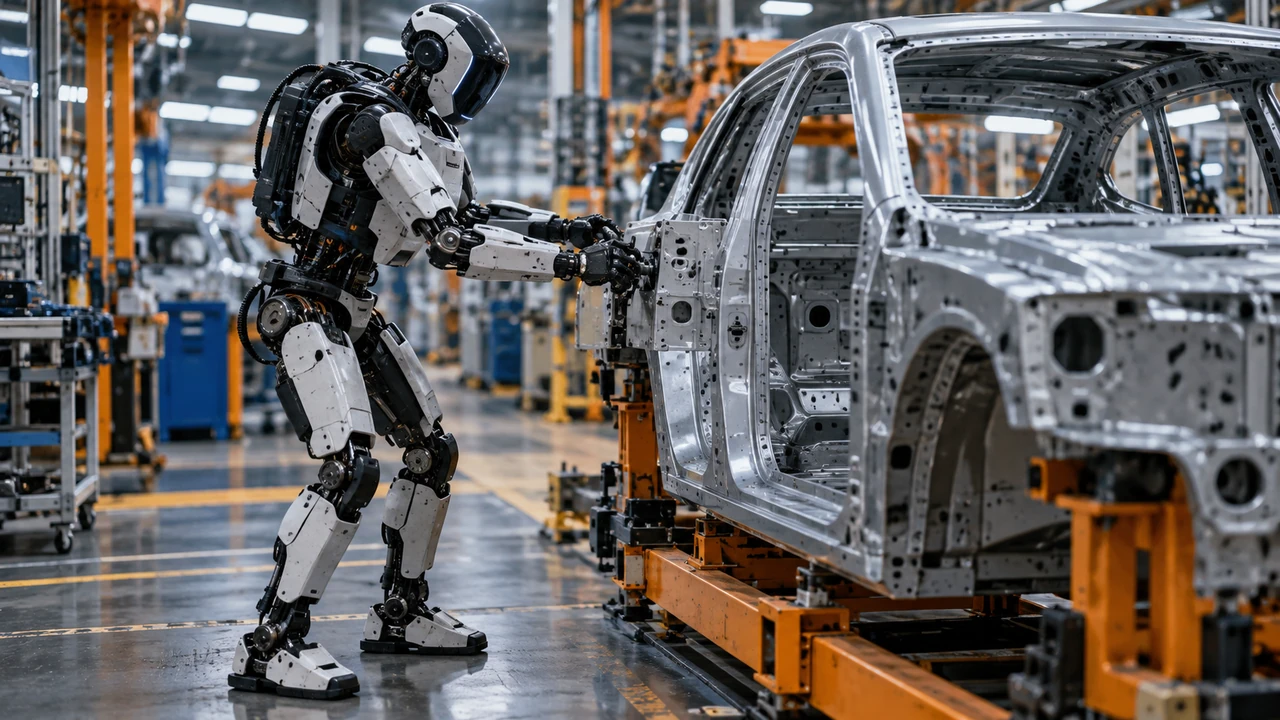
Boston Dynamics has opened a centre inside a Hyundai factory in Georgia to train Atlas on real automotive tasks before any broader industrial deployment.
A laboratory inside the factory
On 21 September 2026, Boston Dynamics announced the Robotics Metaplant Application Center at Hyundai’s site near Savannah, Georgia.
Engineers can now collect data and identify useful work in a genuine automotive environment rather than an idealised laboratory.
Why use a humanoid form?
Factories already use many fixed specialist robots. A humanoid could use the same aisles, workstations and tools as people without rebuilding the line.
That versatility is unproven: for a perfectly repetitive operation, a conventional industrial robot is often faster, cheaper and more reliable.
Atlas must learn real constraints
The electric Atlas is intended for industry. The centre must turn its physical capabilities into repeatable procedures through demonstration, simulation and factory data.
Boston Dynamics announces a target of 25,000 Atlas robots across Hyundai and Kia factories over the next few years, expansion of the centre in 2027 and component-assembly applications by 2030. These are announced targets, not completed deployments.
A market still in its early stages
Professional humanoid sales remain far below annual installations of traditional industrial robots, and many units are still used for trials.
The centre therefore marks an industrialisation phase: determining which tasks genuinely justify a humanoid’s cost and complexity.
New jobs around robots
If trials succeed, human work will shift towards supervision, maintenance, safety, data preparation and mission design.
The factory—not spectacular demonstrations—will show whether Atlas can work regularly, safely and affordably.
Comments 0
Be the first to comment on this article.