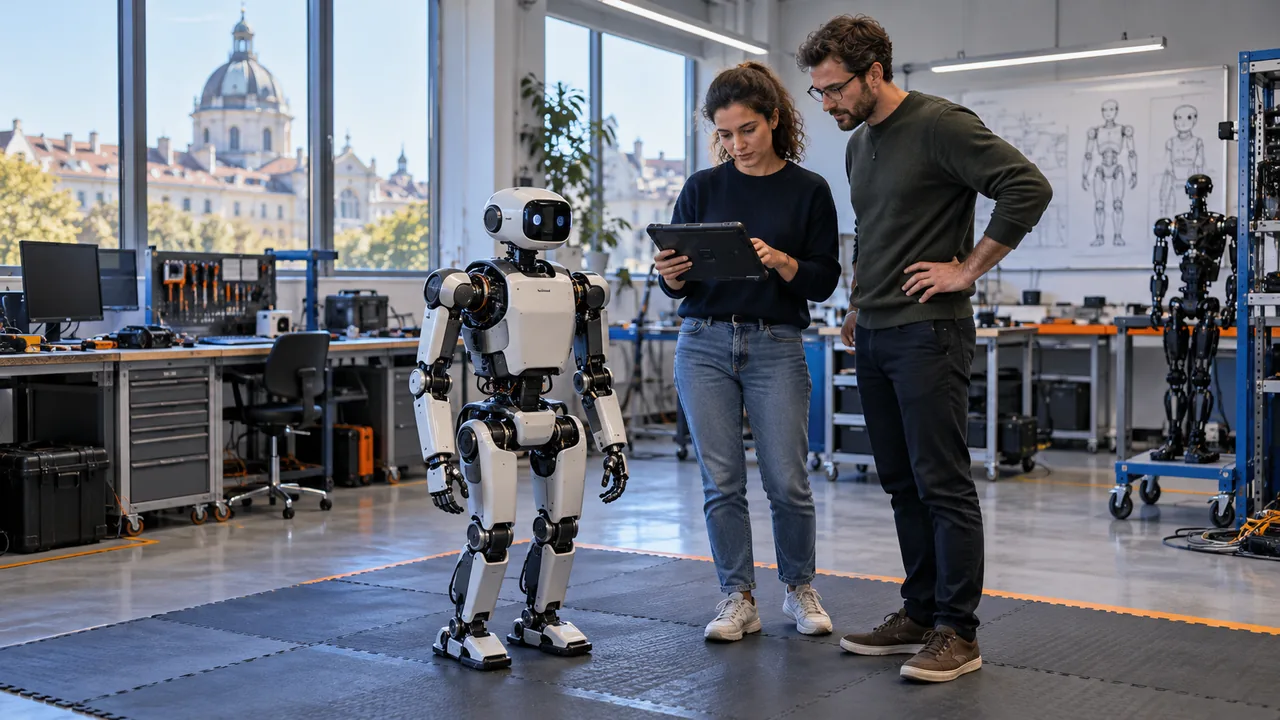
The new robot combines hardware, onboard computing and training tools. It remains a development platform, not a robotic employee available at scale.
An integrated stack for researchers
Agile ONE SN combines a compact humanoid body with the Isaac GR00T platform and Jetson Thor onboard computing. NVIDIA also announced Isaac OS, Isaac Lab 3.0, datasets and simulation pipelines. The aim is to reduce the integration work that often precedes experiments.
The announcement still comes from two companies directly involved. Its presentation at GTC Berlin proves that a demonstrable platform exists, not that it will operate reliably for thousands of hours or be immediately available to every laboratory.
Watch: meet the Agile ONE humanoid robot
Evaluate before deployment
Simulation learning can multiply trials without exposing a person or machine. But behaviour that succeeds in a virtual world must still face friction, unexpected objects and sensor errors in reality.
The planned future integration of the Halos safety stack must likewise be distinguished from an already certified feature. Researchers will need to publish protocols, failure rates and stopping conditions.
NVIDIA Isaac GR00T: training humanoid robots
What this changes for robotics
A common reference can make experiments easier to reproduce and results easier to compare. It can also deepen dependence on one software and hardware ecosystem. Laboratories must therefore examine openness, costs, maintenance and model portability.
For companies, the useful signal will be less a video than a task repeated safely, measurably and at a sustainable cost.
Conclusion
Agile ONE SN brings together building blocks needed for humanoid research. Its importance will be measured by the quality of the evaluations it enables, not by the robot’s appearance alone.
Comments 0
Be the first to comment on this article.