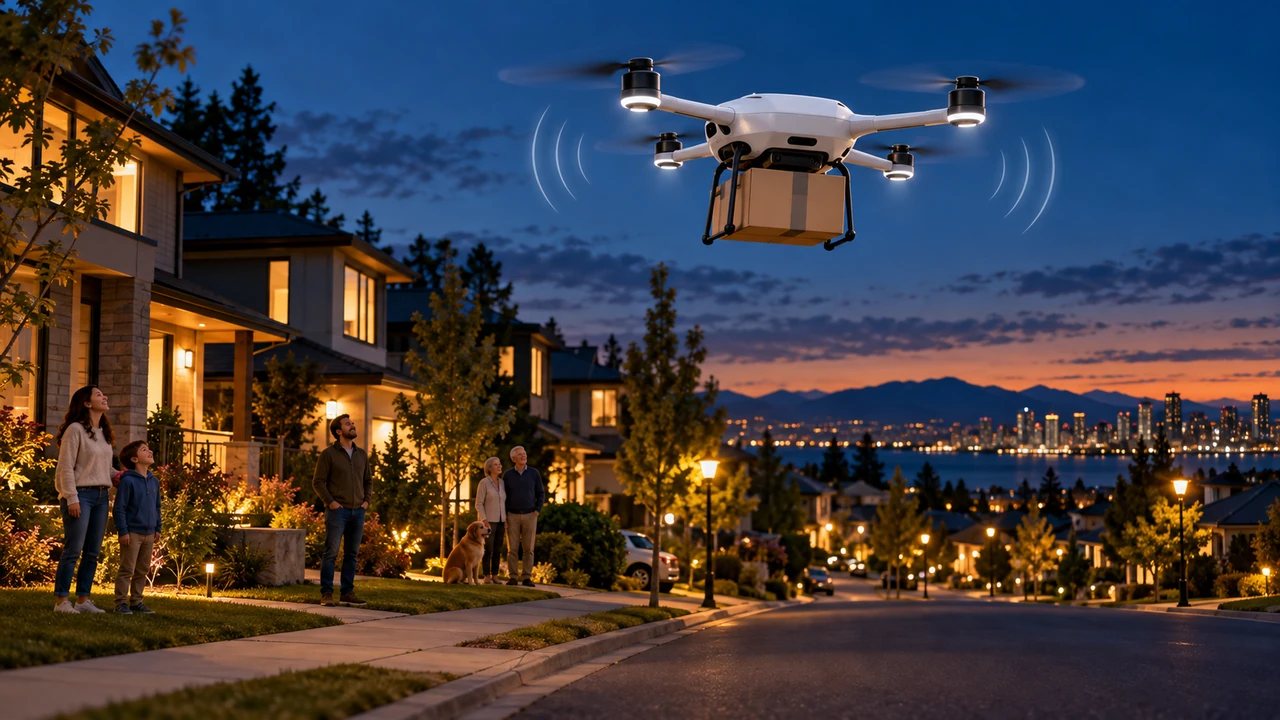
Drone delivery is moving beyond demonstrations. As US authorities prepare for wider deployment, a coalition of states is challenging how noise, safety and local environmental effects have been assessed.
A challenge filed on 28 September
Fifteen states, including California, New York, Massachusetts, Michigan and Wisconsin, together with Harris County, Texas, launched a legal challenge on 28 September 2026.
They contest the FAA’s national environmental assessment, finalised in July. The plaintiffs say it insufficiently considers risks and cumulative effects from a large expansion of aerial deliveries. Those are allegations in a legal challenge, not a court finding.
The consequences of scaling up
Commercial deliveries already operate under certifications and specific authorisations. Flights beyond the pilot’s visual line of sight can serve several neighbourhoods without placing observers along the entire route.
The debate covers repeated noise, residential overflights, nearby parks, possible wildlife disturbance and the placement of logistics hubs. It goes beyond the safety of a single aircraft.
What the FAA assessment says
On 28 July 2026, the FAA signed a decision finding no significant environmental impact from the proposed programme. The official notice making the assessment available was published on 30 July.
According to Reuters, the assessment considers an average scenario of 1,150 deliveries a day from one hub. The documents include restrictions concerning sensitive areas. An environmental decision is not blanket permission to fly everywhere.
Benefits need local measurement
Fast deliveries can be useful for medicines, urgent parts and small products, potentially replacing some road trips.
Environmental benefits depend on energy use, distance and the transport being replaced. Comparisons must cover complete systems, including consolidated road deliveries.
Who bears the nuisance also matters: the customer, the neighbour underneath the flight path or the municipality hosting the hub? Resident information and independent noise measurements are central to public acceptance.
Conclusion
The lawsuit does not permanently rule out drone delivery. It highlights that an urban technology must also be acceptable to people living beneath its routes. The legal challenge and aviation rules will need to be followed separately.
Comments 0
Be the first to comment on this article.