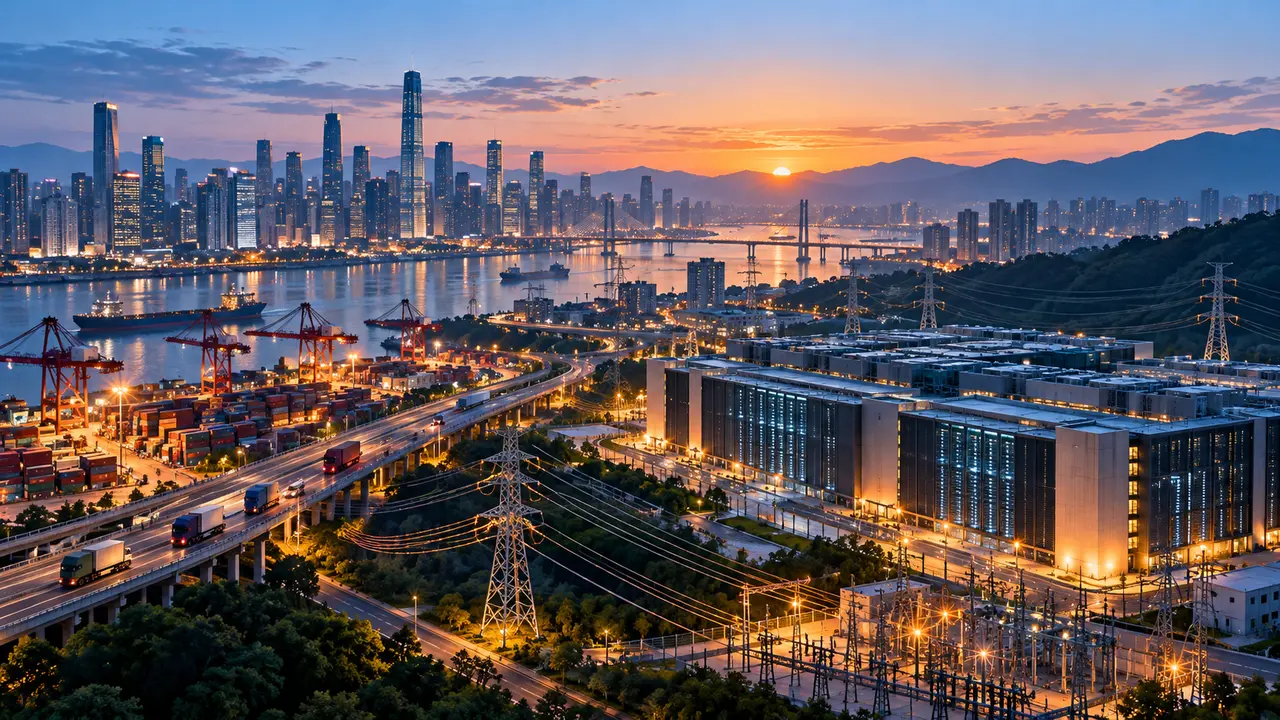
At the opening of the IMF and World Bank meetings in Bangkok, Kristalina Georgieva described artificial intelligence as an investment shock already visible in growth. Asia benefits particularly because of its position in the hardware supply chain.
The first dividend runs through concrete, chips and electricity
AI’s immediate economic impact is highly physical: data centres, semiconductors, electricity grids, cooling and computing capacity. According to Kristalina Georgieva, this wave is both a demand shock and an investment shock.
It could add between half a percentage point and one percentage point to growth in Asia’s advanced economies, and between 0.2 and 0.8 percentage points in the region’s emerging economies. These are estimates, not guaranteed outcomes. In its outlook published on 13 October, the IMF projects global growth of 3.1% in 2026 and 3.4% in 2027. These are forecasts, not achieved results.
Why Asia is central
Much of the value chain runs through Asia: components, assembly, memory, equipment, data centres and digital infrastructure. A data centre also calls on construction, electricity, cooling, maintenance and digital skills.
This knock-on effect can increase pressure on energy, land and water. The macroeconomic gain therefore does not capture its full local cost.
Forty per cent of jobs could be transformed
The IMF estimates that around 40% of jobs worldwide could be enhanced, downgraded, transformed or eliminated over time by AI. That figure measures exposure, rather than predicting the disappearance of four jobs in ten.
Routine tasks are easier to automate; other jobs will gain productivity. One vacancy in ten in advanced economies already asks for at least one new skill, according to the IMF.
Small AI for concrete needs
World Bank president Ajay Banga advocates targeted, resource-efficient systems for agriculture, health and education. AI adapted to local languages and data can be more useful than a huge general-purpose model.
For a clinic or a farmer, usefulness depends on reliability, cost and operation with a limited connection, rather than the number of parameters.
The risk of a new divide
Countries with abundant capital, reliable electricity, skills and data are better positioned. A similar divide separates large companies able to invest from smaller organisations forced to wait.
Networks, training, competition, access to computing power and support for workers will determine how widely the gains spread. AI can support growth; it does not distribute its benefits automatically.

Comments 0
Be the first to comment on this article.