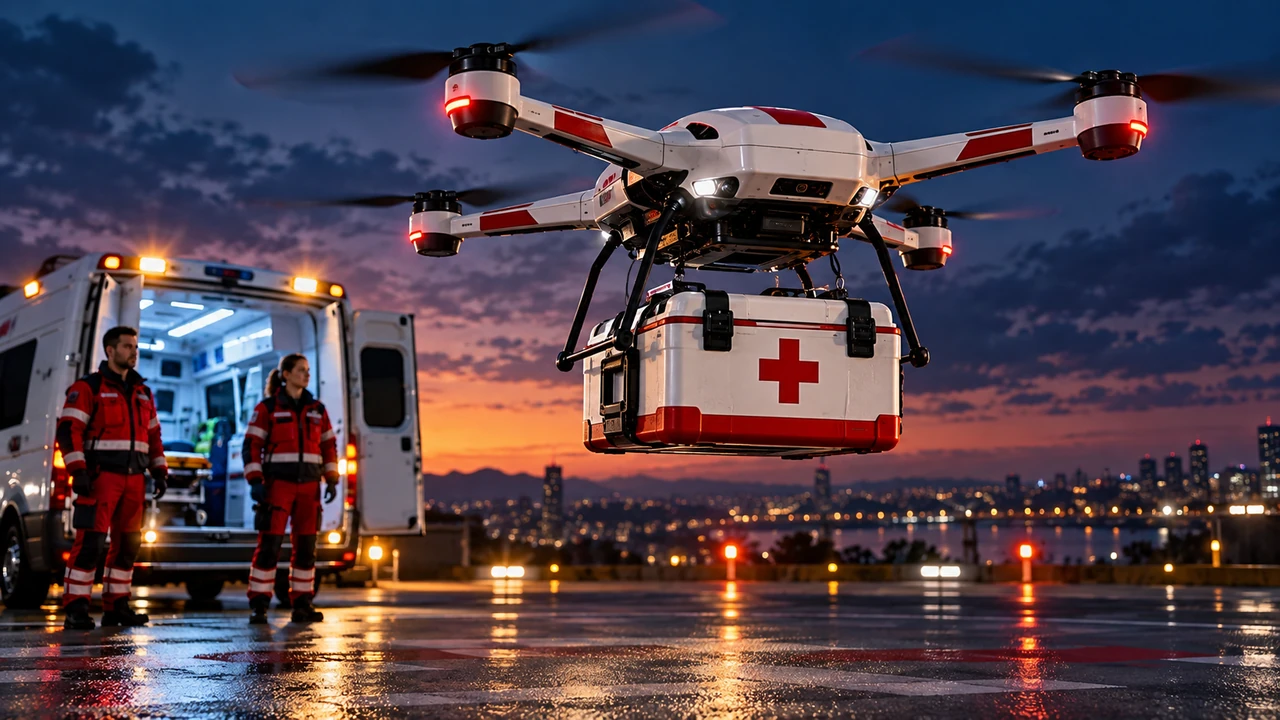
Every minute matters when a patient is losing large amounts of blood. Emergency services in Hillsborough County, Florida, are preparing a drone service that can bring a unit of whole blood to the scene before the patient reaches hospital.
Blood delivered within minutes
Hillsborough County Fire Rescue announced a public demonstration for 28 September 2026, working with Tampa General Hospital, OneBlood and Archer First Response Systems.
The initial service will cover two areas of 35 square miles each, approximately 91 square kilometres apiece. Drones will be based at two fire stations. Programme officials expect average delivery times below three minutes and a maximum of five minutes at the edge of the coverage areas. An official update published on 1 October confirms that the demonstration took place. It does not yet provide results from a regular service: the announced timetable should not be confused with a demonstrated operational launch.
Bringing treatment to the patient
Trauma specialists often use the term golden hour to emphasise the value of prompt care. It is not a guaranteed or universal deadline.
For serious bleeding after an accident, injury or obstetric complication, waiting until hospital arrival may be too long. Not every ambulance can routinely carry appropriate blood supplies.
The drone addresses that logistical problem: blood remains in controlled storage until a 911 operator or paramedic requests it. Storage conditions, including temperature, must remain controlled during transport.
An operation under supervision
The FAA has granted a waiver allowing flights beyond the remote pilot’s visual line of sight. ArcherFRS will support flight monitoring, maintenance and piloting.
Qualified professionals will perform the transfusions. The drone makes no diagnosis and delivers no treatment itself; it carries a medical resource that is difficult to distribute in advance.
A pilot before expansion
Live operations are expected to begin in October 2026. The first year will be a proof of concept before any wider rollout.
Evaluation must compare promised and actual delivery times, verify blood preservation and document interruptions. Weather, an unavailable delivery area or an airspace restriction may prevent a flight, so backup logistics remain necessary.
Conclusion
The project’s value lies in potentially shortening the interval between an emergency call and a first transfusion. If clinical and operational results are convincing, the model could help other regions where distance delays access to blood.
Comments 0
Be the first to comment on this article.