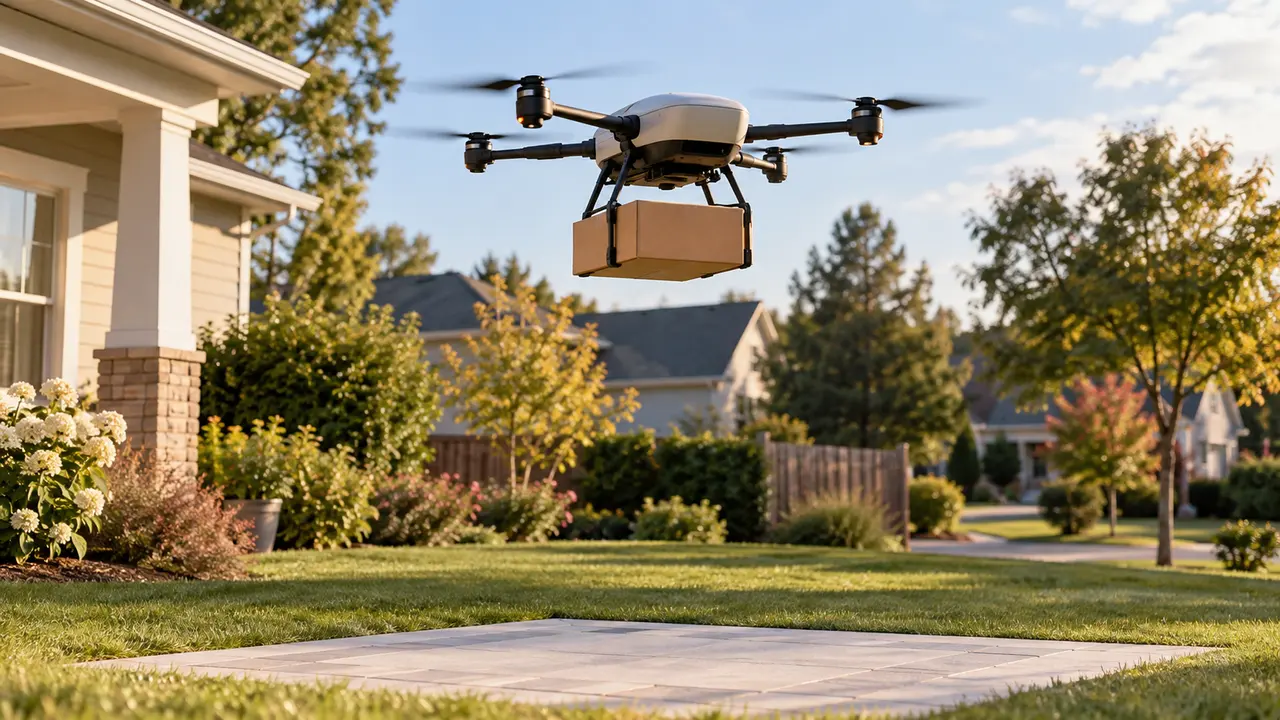
Thirteen years after Jeff Bezos first presented his ‘octocopters’, Amazon says it is ready to accelerate. Prime Air aims to reach nearly 500 US communities and tens of millions of potential customers by the end of 2026. The service handles light parcels of up to five pounds, roughly 2.3 kilograms, using the MK30.
An old promise enters its industrial phase
The aircraft does not land: it hovers a few metres above the ground and releases the parcel. Amazon highlights a detect-and-avoid system designed to monitor the environment in flight. The company says it has already made hundreds of thousands of deliveries in 2026.
Speed alone does not create a use case
Receiving medicine, a charger or a forgotten ingredient in thirty minutes can be useful. But not every purchase warrants a flight. The model will depend on order density, aircraft utilisation, weather conditions and the cost of local infrastructure.
Each launch also requires aviation approvals and often the agreement of local authorities. Past incidents and noise complaints show that trust cannot simply be declared. Navigation cameras, even when not intended to film people, also raise legitimate questions about data collection and retention.
A new way to share residential space
If the rollout succeeds, drone delivery could reduce some short road trips and offer benefits to suburban areas. It will not eliminate vans or couriers: heavy loads, dense apartment blocks and addresses without a drop-off area remain difficult.
The real question is therefore how many deliveries can be made safely, quietly and profitably on an ordinary day. The coming months will provide much more revealing data than an isolated demonstration.
What to take away
Prime Air is gradually leaving the laboratory. Its success will depend less on the elegance of flight than on becoming a quiet, reliable and economically credible neighbour.
Comments 0
Be the first to comment on this article.